Local fillable PDF
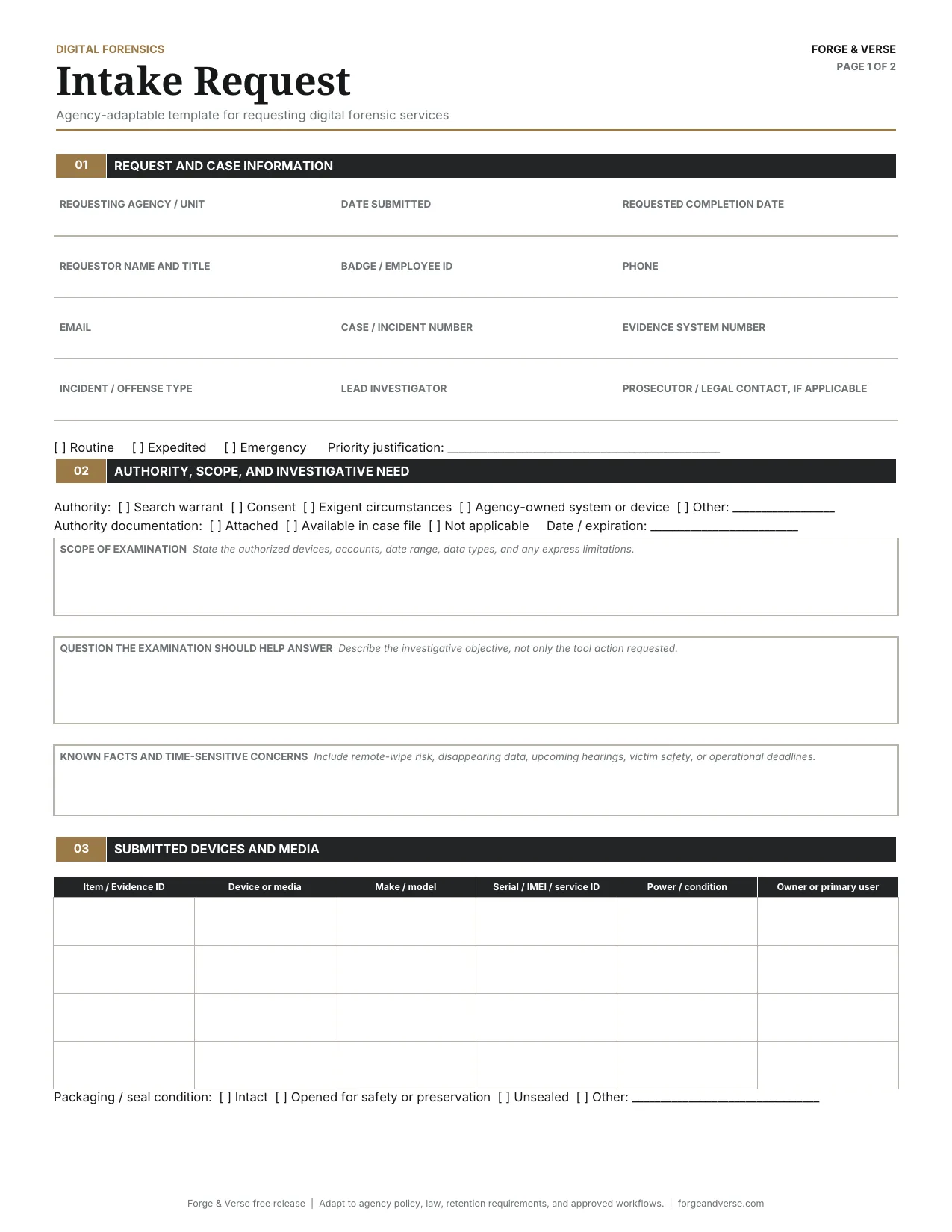
Type into 105 fields, save the file locally, and print or route it through an approved agency process. The PDF contains no JavaScript, telemetry, or automatic submission.
Free work · The Examiner's Bench
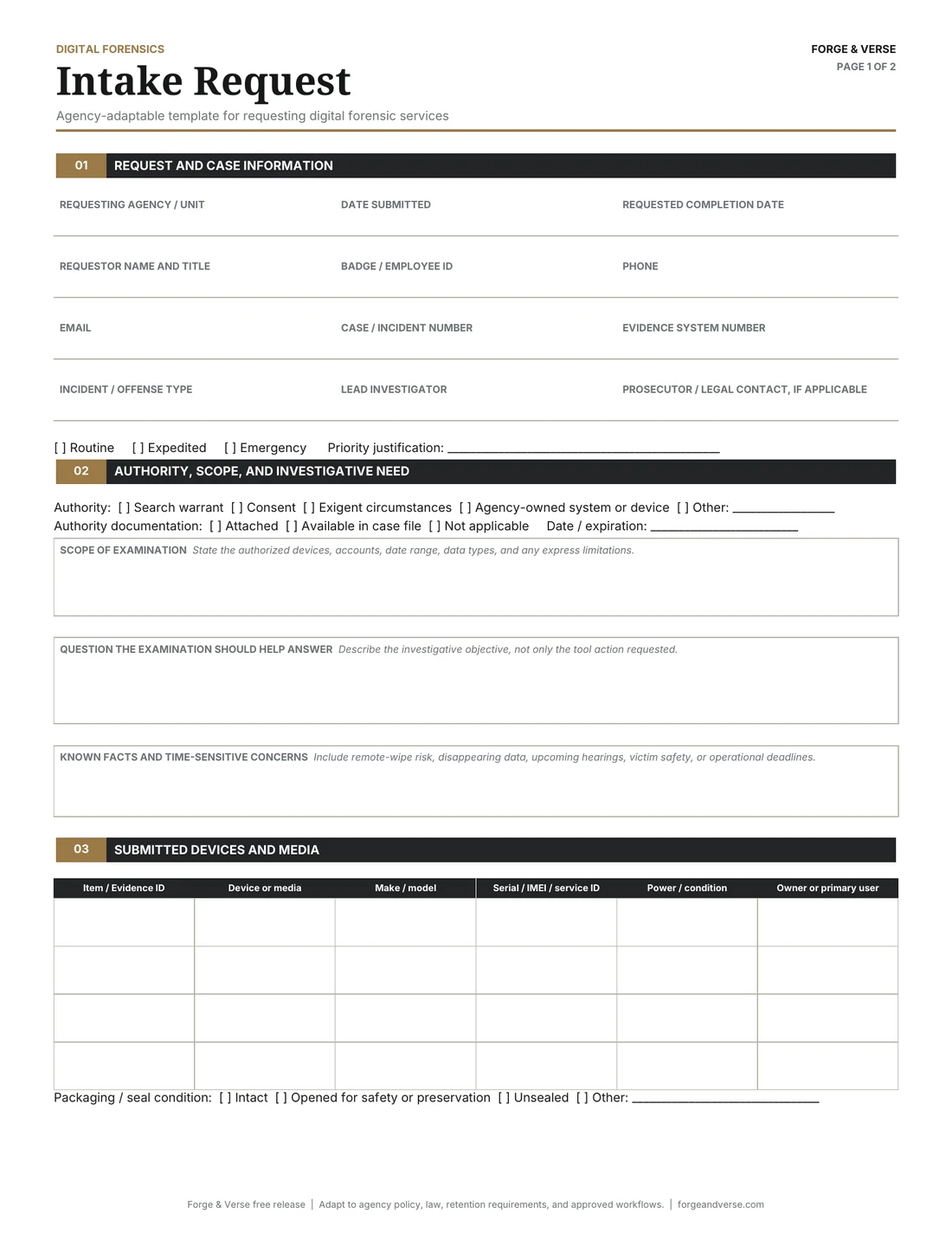
An agency-adaptable request form, requester guide, and implementation guide with print, fillable, and editable paths for handing examiners the authority, scope, evidence details, and investigative question needed to begin well.
Version 1.2 · Updated August 5, 2026
Digital forensic units receiving requests from officers or investigators
When an officer or investigator knows what they need answered, but the request still has to survive the handoff into a forensic unit.
Reduce avoidable clarification and create a more reliable handoff from investigative need to forensic examination
Print PDF + fillable PDF + editable sources + guides
Choose the working style
The release does not assume every department, requestor, or examiner wants the same interaction. Start with the version that fits the actual handoff.
Type into 105 fields, save the file locally, and print or route it through an approved agency process. The PDF contains no JavaScript, telemetry, or automatic submission.
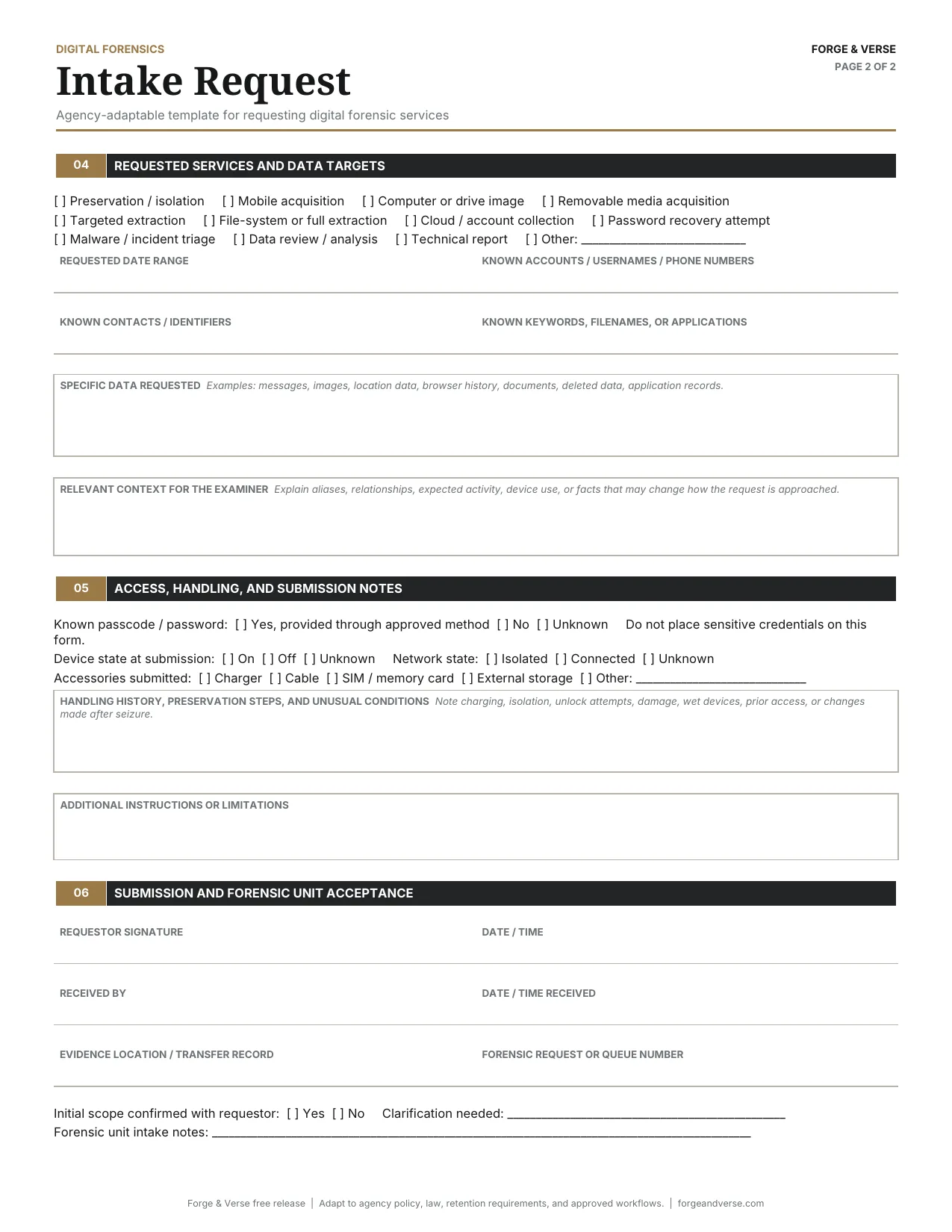
Use the same two-page structure in a paper-first intake, signature, or in-person handoff process without forcing the requester into another screen.
Change branding, routing, approval fields, terminology, services, and local instructions before the form becomes an official part of an agency workflow.
Local by design. The fillable PDF saves entered values inside the file. It contains no form submission action, telemetry, or connection back to Forge & Verse.
Inside the release
The same intake structure now supports three real working preferences: type locally in a fillable PDF, print and write by hand, or adapt the editable source for an agency workflow. The guides support the handoff around the form.
All print, fillable, and editable form files; requester and implementation guides; field map; use terms; release notes; and component checksums.
Download bundleLocal-only two-page form with 105 text and checkbox fields. Saves entered data in the PDF and does not transmit it.
Download Fillable PDFPrint-ready two-page form for authority, scope, objectives, submitted evidence, targets, handling, and unit acceptance.
Download Print PDFAgency-adaptable source file for branding, routing, approvals, evidence-system fields, and local terminology.
Download Editable DOCXMachine-readable list of all 105 field names, labels, types, and page locations for form review or workflow mapping.
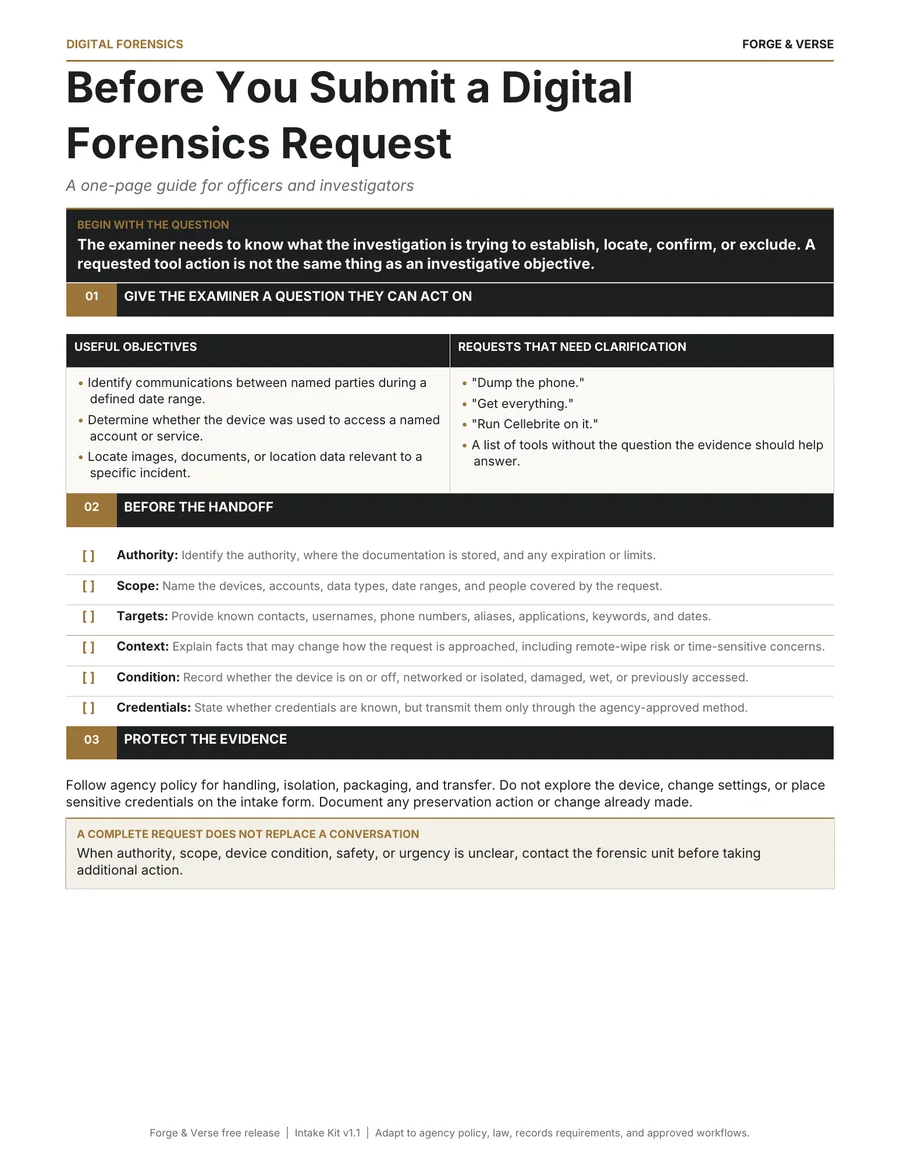
Download JSONOne-page handout that teaches officers and investigators to provide an objective, authority, scope, targets, context, and device condition.
Download PDFEditable handout for local terminology and approved handling instructions.
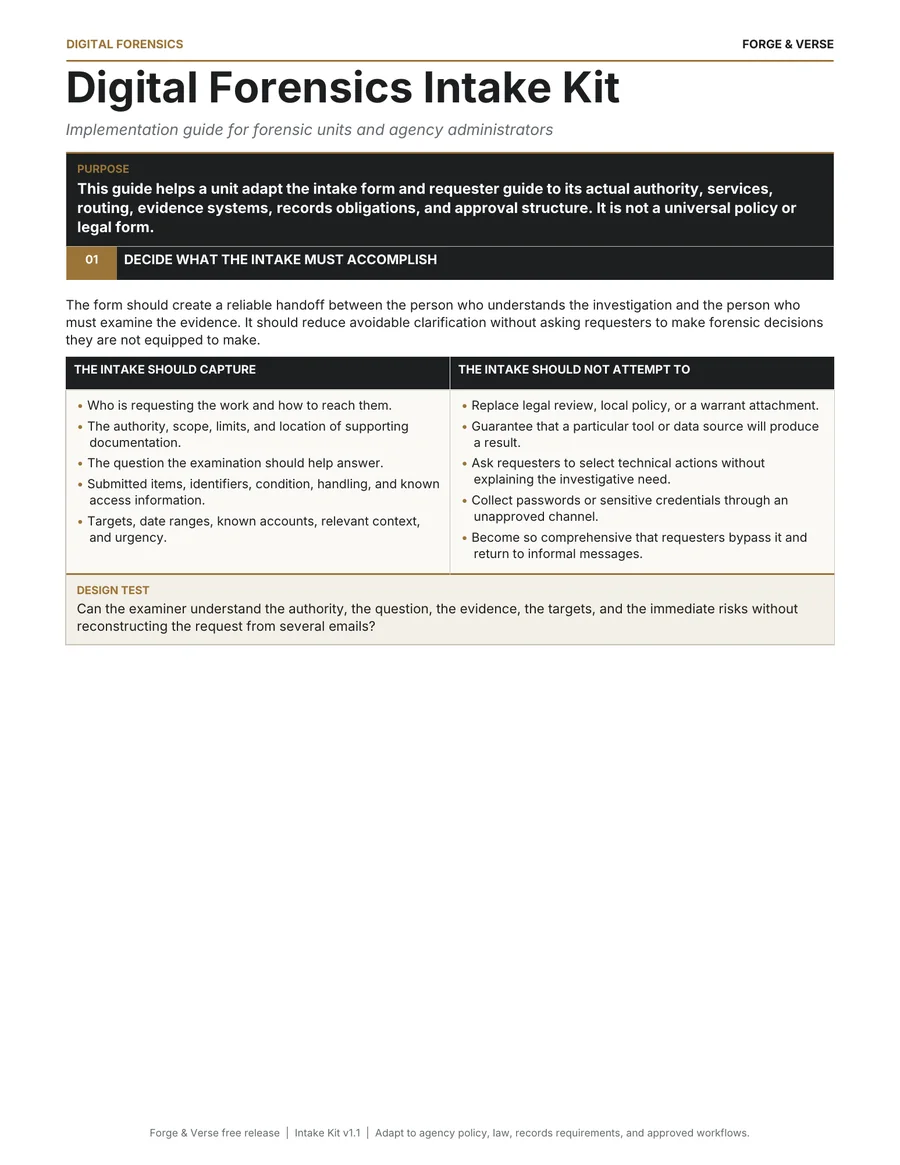
Download Editable DOCXFour-page guide for adaptation decisions, pilot rollout, field rationale, version control, and records discipline.
Download PDFEditable source for agency-specific training notes and implementation planning.
Download Editable DOCXBuilt around the handoff
The requester guide helps officers prepare a useful submission. The implementation guide helps a forensic unit adapt and maintain the release.
Use it when
What it captures
Before you deploy it
From download to workflow
The files are ready to review, not ready to bypass local judgment.
Compare the files with local law, policy, services, records obligations, evidence procedures, and prosecutor expectations.
Change the editable files to match the unit's authority choices, routing, identifiers, approvals, and approved credential method.
Run realistic requests through the complete handoff and note missing information, unclear fields, and workarounds.
Place one approved version in a controlled location, remove superseded copies, and name the owner of future revisions.
A weak intake creates avoidable back-and-forth. An examiner receives a device, but not the question the examination is meant to answer. The legal authority may be somewhere else. The requested date range is unclear. A known passcode exists, but nobody knows who has it.
The intake form gives the requesting officer or investigator one place to describe the examination in terms an examiner can act on. It emphasizes investigative objectives because “extract the phone” is an action, not a question.
The rest of the kit supports the handoff around the form. The requester guide explains what a useful submission looks like before the device reaches the unit. The implementation guide helps an agency decide what to customize, how to pilot the workflow, where completed requests become records, and how to prevent old copies from lingering after the process changes.
The print PDF is ready for a paper-first handoff. The fillable PDF supports local typing and saving without sending data anywhere. The DOCX files are intentionally editable so a department can add its own routing instructions, approvals, evidence-system fields, legal language, services, and branding. Test the fillable edition in the agency-approved PDF viewer before operational use because save, print, and signature behavior can differ between viewers.
This is a starting framework, not a universal policy or legal form. Review it against local law, agency policy, prosecutor expectations, retention requirements, accessibility obligations, evidence procedures, and the actual services your forensic unit provides before operational use.
You may use, modify, reproduce, and distribute an adapted version within your organization for operational, administrative, or training purposes. Attribution is appreciated but not required after adaptation. Do not resell the kit as a standalone item or present an altered version as an official Forge & Verse release.
Follow the thread
A useful object, a practice note, and a developing study can approach the same working moment from different directions.
Release history
Added a local-only fillable PDF with 105 fields, a machine-readable field map, and a public JSON release manifest. The print-ready PDF and editable DOCX remain separate choices rather than forcing one workflow.
Expanded the original form into a complete kit with a one-page requester guide, four-page implementation guide, editable source files, bundled release, and component checksums.
Initial two-page intake request released as print-ready PDF and editable DOCX.
Verify the download
Compare the SHA-256 value after download when file integrity matters in your workflow.
Download checksum manifest Download release manifest JSON91ef34615c97a432bdb2c93d40bcc498da006f4ba12aea1ea0d3f72e7bae089c10c361e4c03a19b6c83f9e33caa1a1299c50e27c484a37600f6a197bc359dbe30da8ca48173e9279bc69d7e30ecfd62d32d1d52de0d31630bb6447a624245cc2062f2a56ea3b4d5f2bbcfd9baacd580641e582160fe9fe24f184a155fa694ac9937e529dd5b51c5a3e132f1c0d73f63e635656d3cbe51c3f3bc0e0edb3957ffe3f435c5af70e1822b80de0a59aa3d9460c0157e1dc603d6691c690378835de11579e1c1f0d2f48ad676e47671379b67b6ac85f88a4e3fc9aaf11b03a6d3cd200