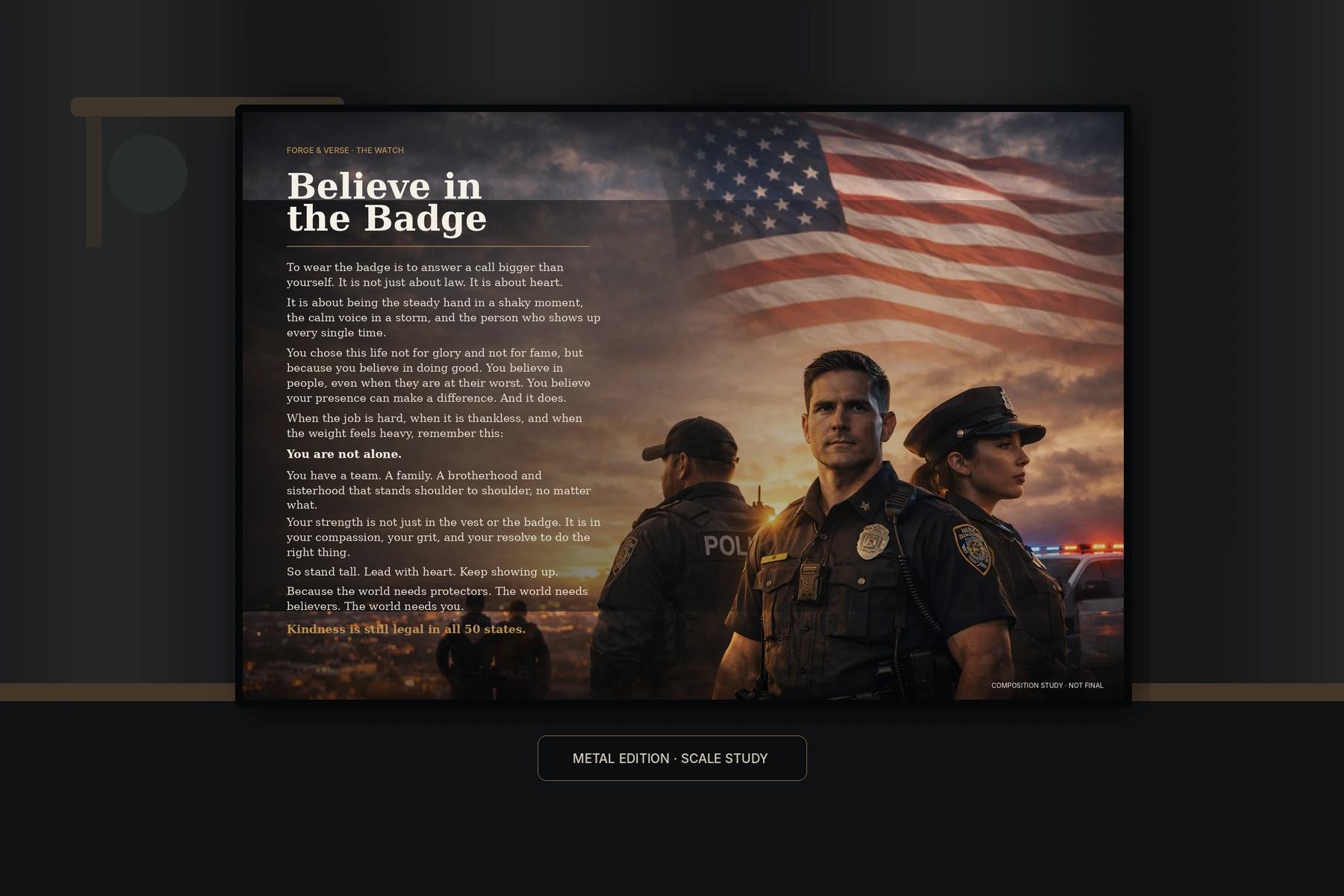
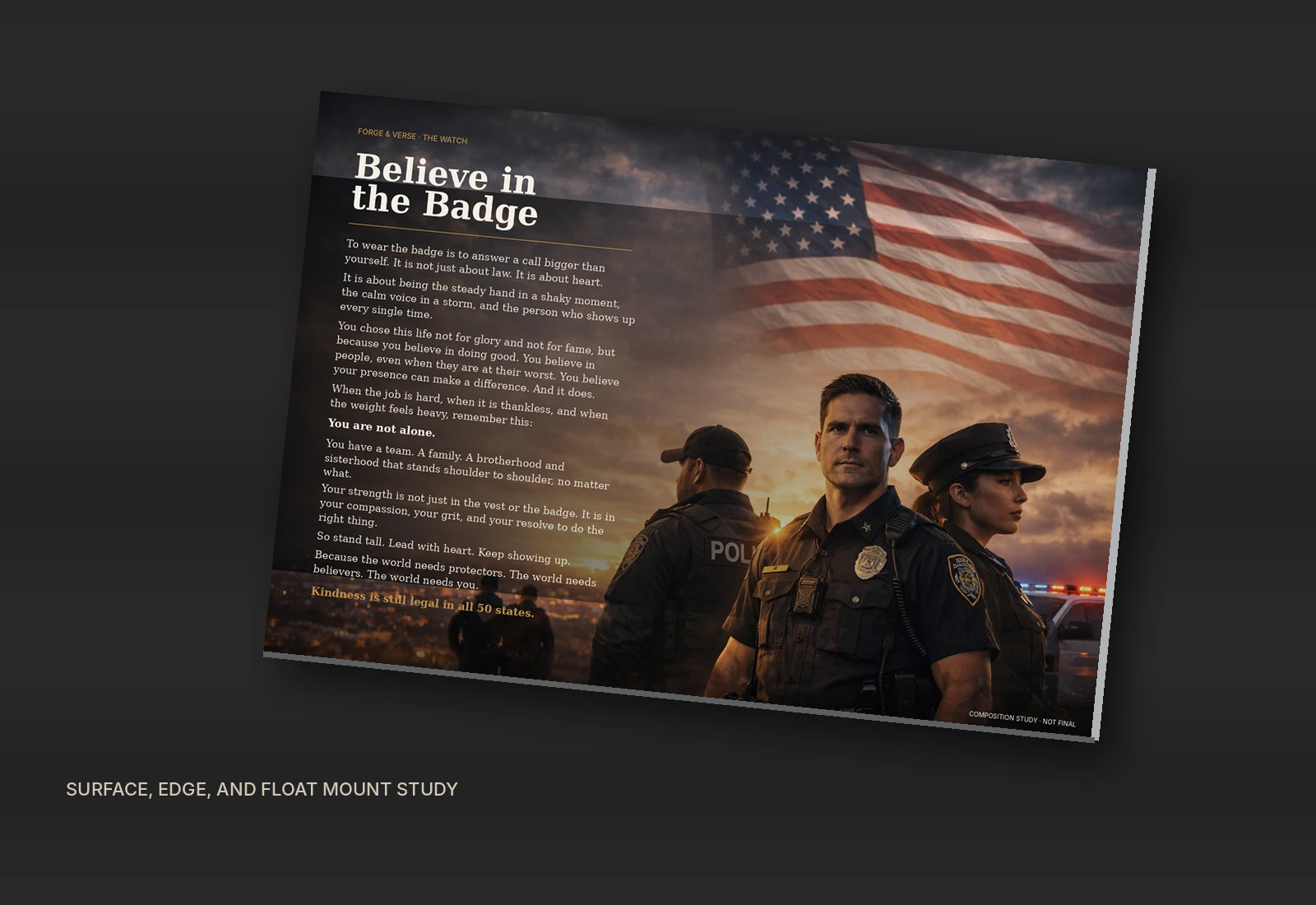
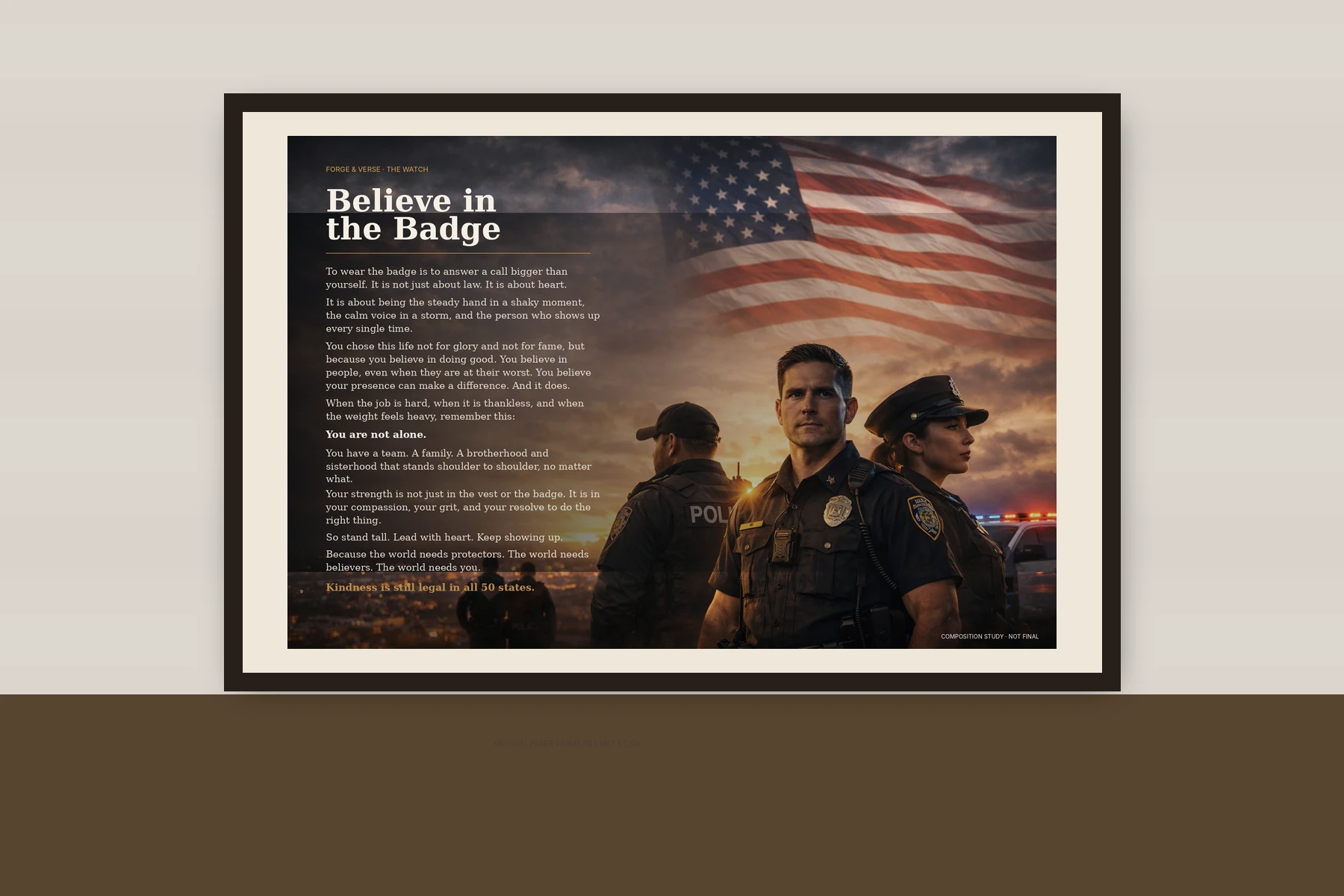
The most useful v20 discovery is a blocker
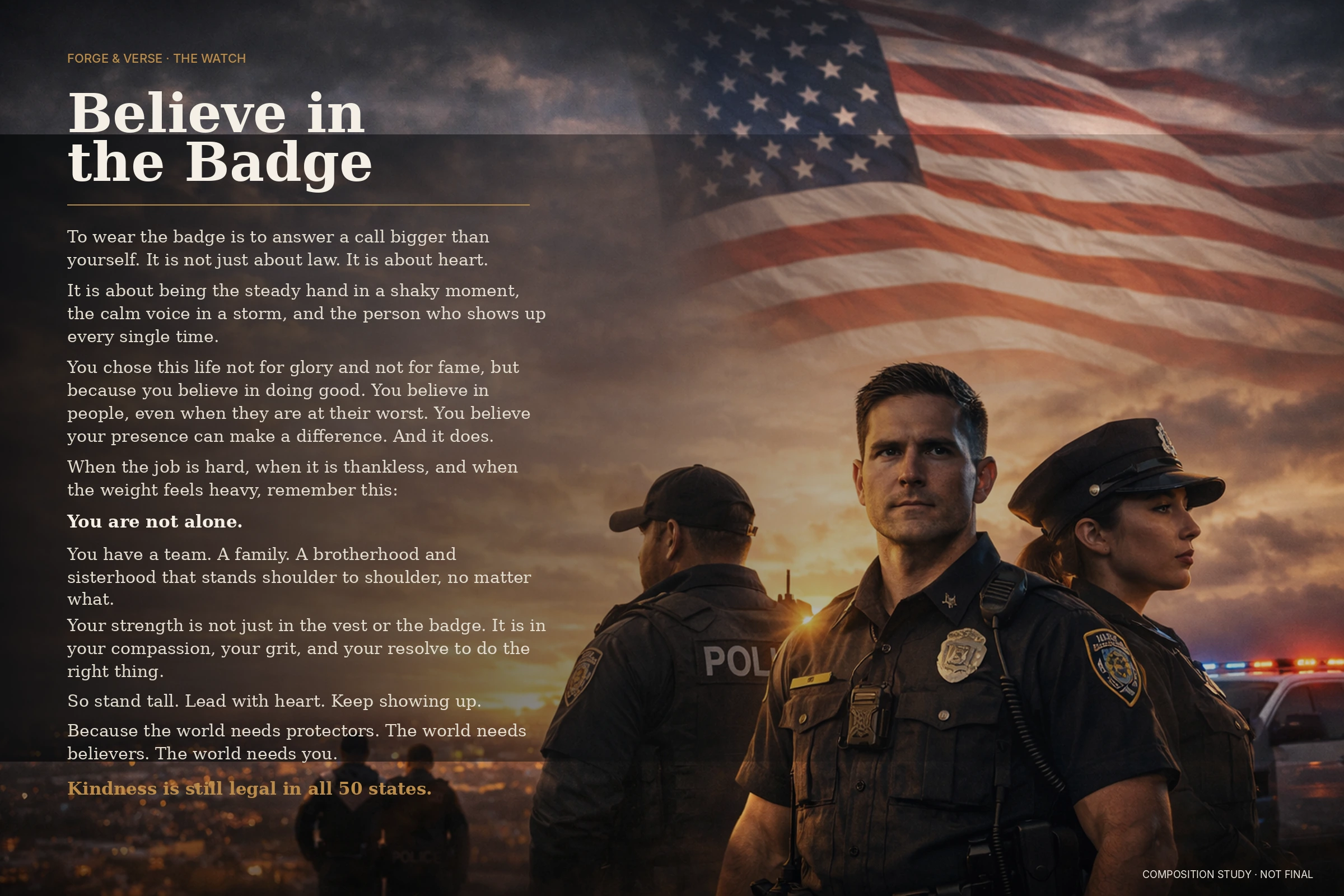
The room studies did their job. They showed that the piece can hold a professional wall without needing more symbols, more police imagery, or more decorative language.
They also made it tempting to call the piece nearly production-ready.
It is not.
The current underlying backdrop is 1536 x 1024 pixels. At the working 36 x 24 inch metal target, that source would provide only about 42.7 pixels per inch before crop or recomposition. Upscaling it would create a larger file, not a premium master.
That matters more than another mockup.
Working physical targets
The composition keeps its 3:2 ratio. Two formats are worth carrying into the next real sample:
- 36 x 24 floating metal for a briefing room or shared professional space.
- 30 x 20 archival paper with a substantial frame for a quieter, reading-led office presentation.
Until a production partner supplies an exact template, the working preflight uses a 0.25 inch bleed outside trim and keeps critical text at least 0.75 inch inside the trim edge. Vendor specifications will override those temporary values.
For the 36 x 24 target, the photographic master should be at least 5400 x 3600 pixels for 150 ppi at final size; 7200 x 4800 or higher is preferred when the source supports it. Typography and linework should remain vector where possible.
Why the study moved back to Material
The studio progress scale is supposed to mean something. Step four is for a physical or production-ready sample. The current room mockups are neither.
So the study moves from Sample back to Material until the image source, output geometry, and finish requirements are real enough to order a sample without hand-waving.
That is progress, even if the number got smaller.
The physical test is already defined
Once the master artwork is ready, the sample has to survive several ordinary conditions:
- full copy readable from roughly three to five feet
- title and composition recognizable across the room
- deep blacks retaining detail under office lighting
- controlled reflection from front and oblique angles
- edge and float depth supporting rather than distracting
- metal and framed paper judged in the same room
The production-preflight PDF in the studio source records those gates so the next step is a test, not another mood board.