On the Anvil · The Evidence Room

Art direction reset

Preserved Until It Matters

A property-and-evidence wall study that now makes custody over time the visual subject instead of centering one sentimental object.

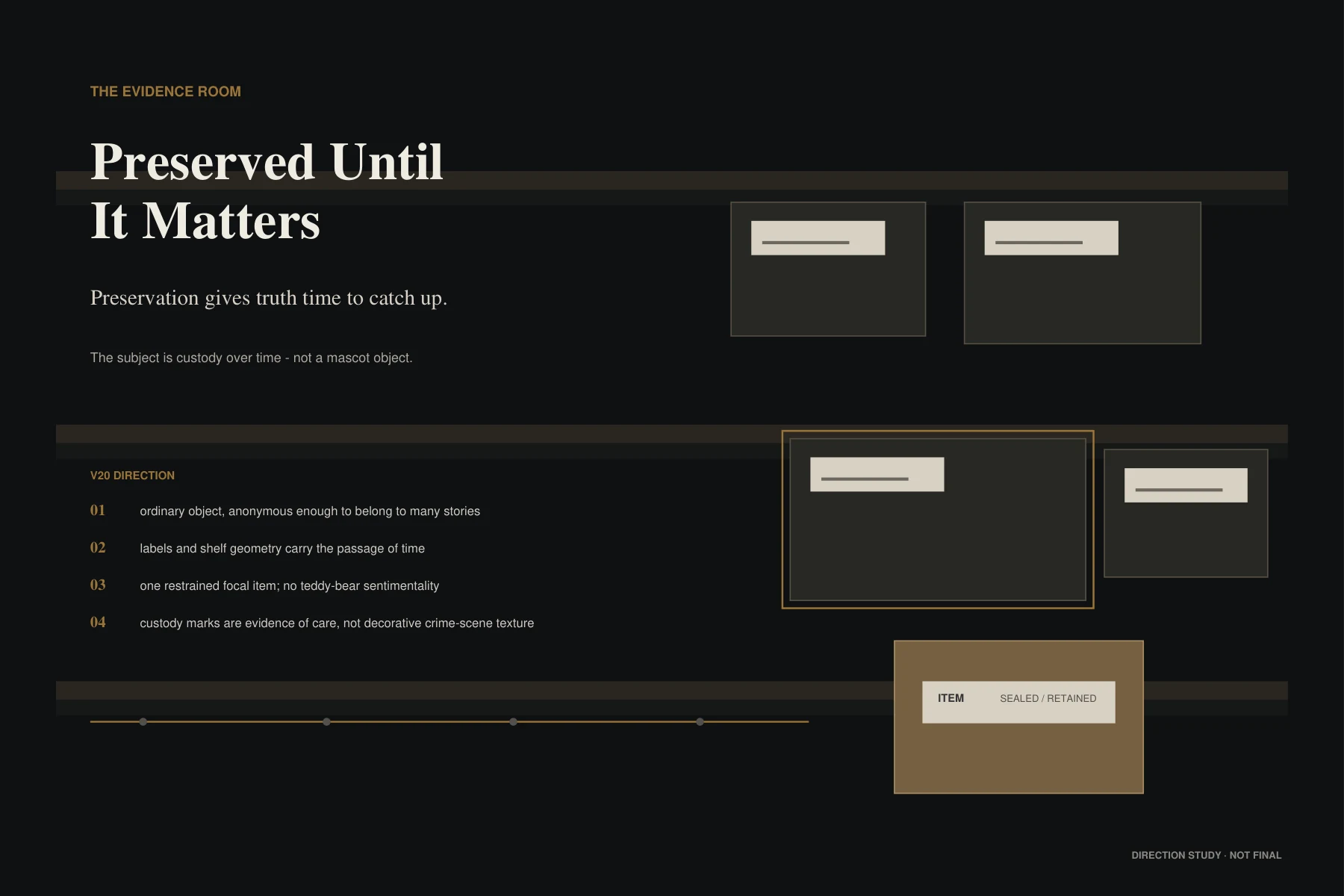
Preserved Until It Matters v20 direction study with quiet evidence-shelf geometry and an anonymous sealed item rather than a teddy bear.
For

Property and evidence professionals whose best work may not reveal its value for years

When

When the long consequence of careful custody deserves to be visible in the room where that work happens.

Why it exists

Give visual weight to the patience and discipline that preserve future answers

Form

Mounted wall edition

Taking shape

The study moves only when the current question is resolved well enough to earn the next one.

QuestionThe person and the need are clear enough to begin.
StructureThe words, layout, and working form are being resolved.
MaterialSurface, scale, construction, and finish are being matched to the piece.
SampleA physical or production-ready sample is being tested.
ReadyThe work has passed its release test.

Prototype proof

Custody becomes the subject

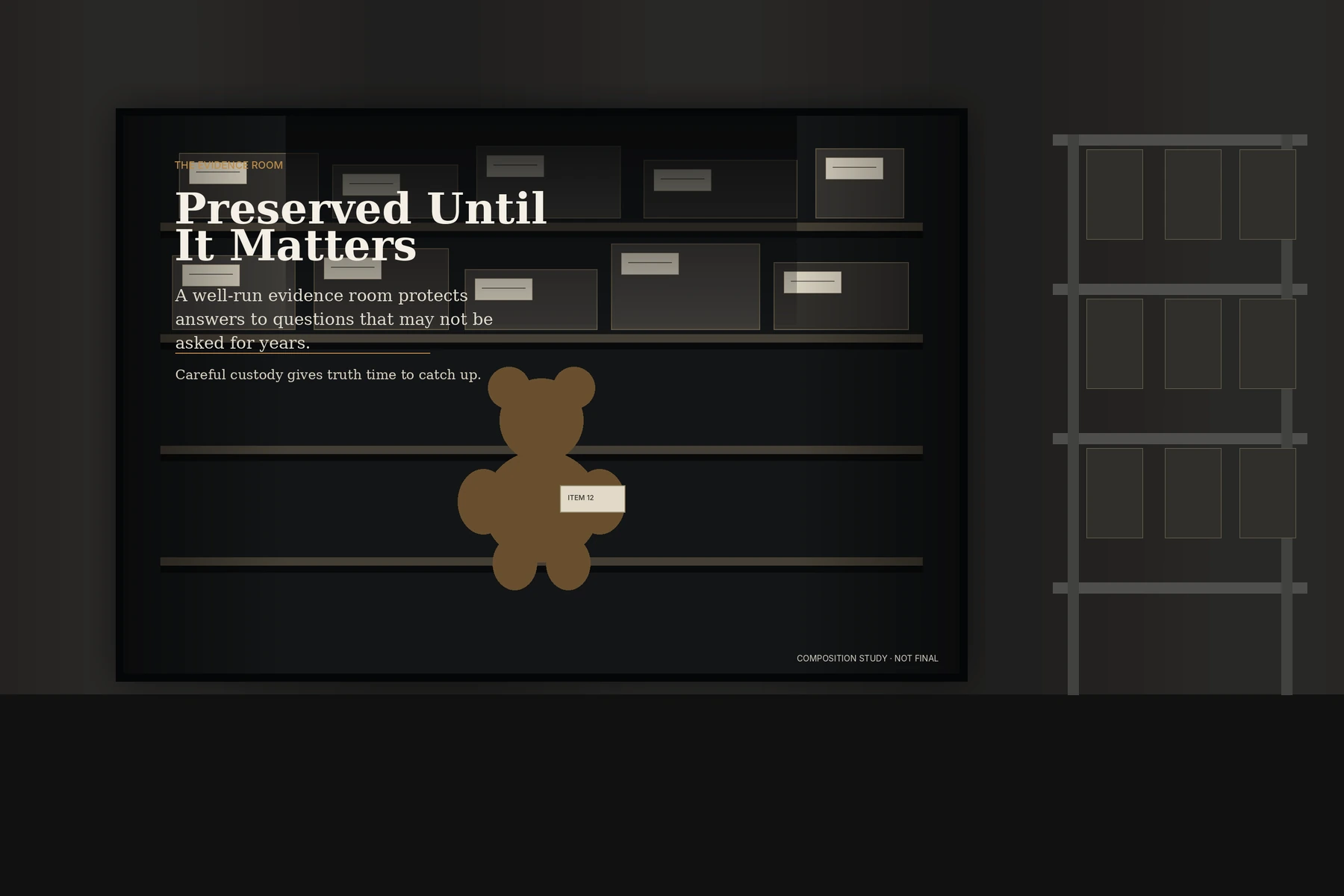
The first composition taught the studio something useful: the teddy bear was memorable enough to become the story. That is exactly the wrong hierarchy for a piece meant to honor a system of careful custody across many kinds of cases. The v20 direction removes the mascot object and lets shelving, generic labels, seals, and elapsed time carry the consequence.

V20 Preserved Until It Matters direction study with generic evidence packages, shelf architecture, and one anonymous sealed item. Open proof
Current direction. The ordinary item is deliberately anonymous; continuity, not sentimentality, is the visual center.
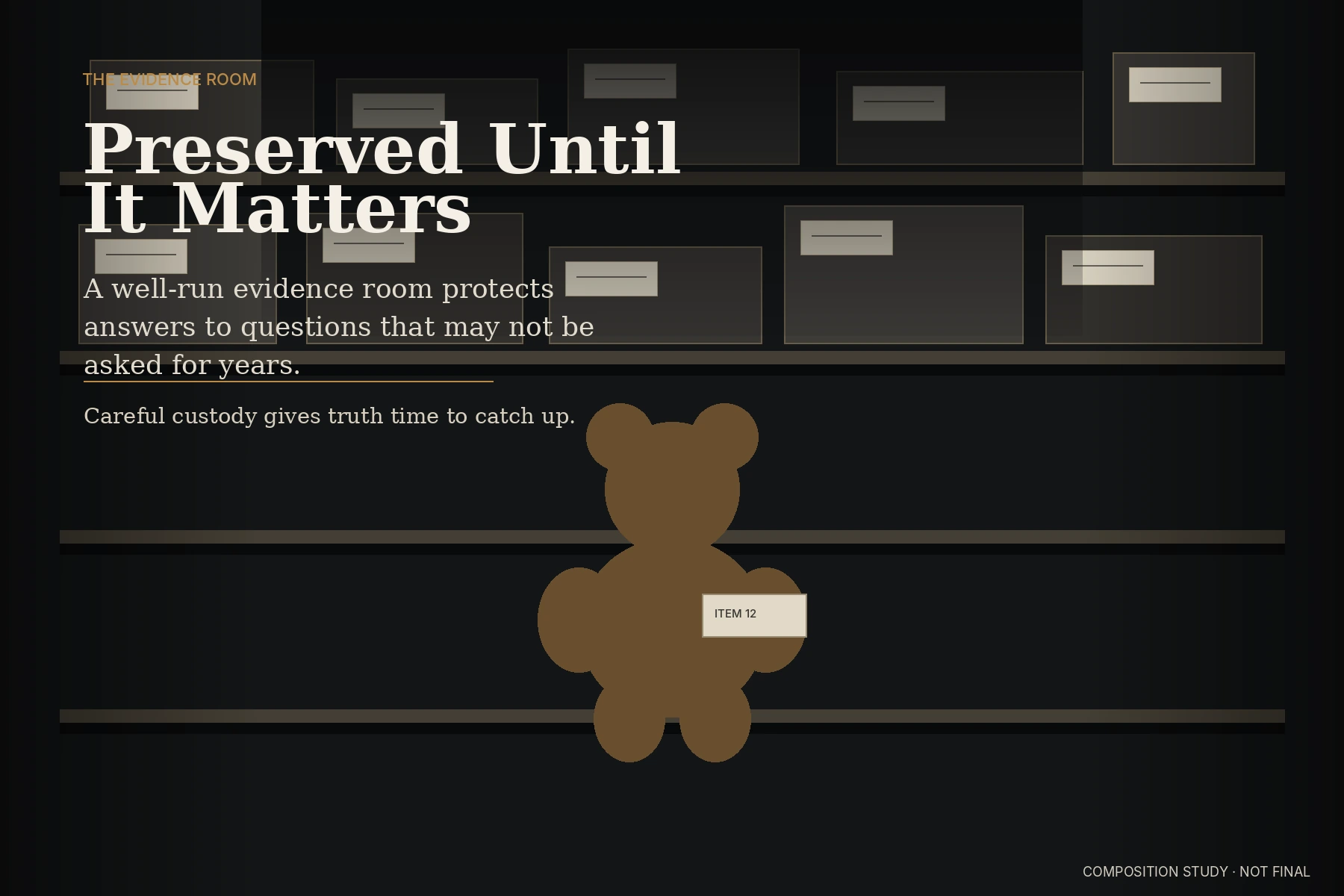
Earlier Preserved Until It Matters composition with evidence shelves and a teddy bear silhouette. Open proof
Retired first composition. It proved the core thought but made one object too specific and too emotionally directive.
Earlier Preserved Until It Matters wall mockup in a dark evidence-room setting. Open proof
Earlier room proof retained as scale history. The next wall mockup should use the new custody-centered direction.

What the first proof got wrong

The original teddy-bear composition came from a meaningful truth: an object can sit quietly in evidence for years before a later fact gives it extraordinary significance.

As a story, that works.

As the central visual for Forge & Verse, the bear started doing too much. It made the piece feel like it belonged to one anecdote instead of to the people who preserve thousands of ordinary objects without knowing which one will matter later. It also pulled the work toward sentimentality when the stronger subject is discipline.

The v20 direction retires the bear as the hero.

Custody over time becomes visible

The new visual grammar uses things an evidence professional actually lives with:

  • shelf geometry
  • generic labels
  • seals
  • repeated identifiers without real case information
  • one ordinary, anonymous retained item
  • a long horizontal rhythm that can suggest elapsed time without drawing a literal timeline

Those details are not there to make the piece look “forensic.” They are evidence that someone received, identified, stored, and preserved the item carefully enough for a future question to remain possible.

The central thought stays

Preservation gives truth time to catch up.

That line survives because it describes the value of the work without requiring a dramatic object. The title carries the long horizon. The visual should make that patience feel physical.

What the next composition must avoid

The next art proof should not use a generic crime-scene aesthetic, glowing evidence tags, yellow tape, weapon silhouettes, fingerprint overlays, or invented case details. It should also avoid borrowing the specifics of the story that originally inspired the idea.

The goal is recognition, not costume.

The next honest gate

The direction is stronger, but the art is not finished. The next round needs one full composition built from this custody-centered grammar and then judged on paper and low-sheen metal at realistic wall scale.
Follow the thread

The idea continues elsewhere.

A useful object, a practice note, and a developing study can approach the same working moment from different directions.